

S2 Multisport North Sydney [Wed] Rules
MULTISPORT SPECIFICS
Multisport is a league which requires teams to play in their same team each week, but every week each team is required to compete in different sports, as selected by the League Manager. Below is a summary of each sports rules, and team requirements. This league is a mixed 5-a side league, with most sports requiring 5 players on the court, or field at any one time. All games will run for around 40 minutes.
THE TEAM
5-aside:
-
The number of players shall be five (5) players.
-
The team must include a minimum of two (2) male, two (2) female and all remaining players can be any gender including gender diverse people.
-
Substitutes can be used as long as they have created an account and signed the most up to date Urban Rec waiver. During game play, substitutes can be made at any point in the game.
GAME SPECIFICS
GAME TIME: The games are played in two (2) 18 minute halves (with the exception of Netball, Hoopla & Kickball) with a few minutes break at half time.
COURT BOUNDARIES: The game shall be played on the available courts at our Multisport venue. Any particulars about the court or field will be detailed in the particular sports rule breakdown.
BASKETBALL SPECIFIC RULES
THE BALL: The ball can be advanced up the court with the hands only, either by dribbling or passing to teammates.
HALF COURT DEFENCE: When the ball is being thrown in from the baseline after a basket has been scored, all defensive players must make their way back to half way before defending. This is also relevant after a defensive rebound or turnover has been made. All decisions and calls on this are at the Event Hosts discretion.
FOULS: Fouls are penalties assessed for rough play. Fouls are awarded either out of bounds or if in the act of shooting, two (2) free throws are awarded. Players are expected to call themselves when they foul another player, if a player thinks they have been fouled it is then the Event Hosts final call.
Here are a simple list of reasons players would be called for a foul:
-
Blocking – Caused when the defender makes personal contact with an opponent who may or may not have the ball. Blocking is called when the defender impedes the progress of the opponent.
-
Screening – Avoid setting any dangerous screens that may impact a player when they’re not looking. This can cause head clashes and serious injuries.
-
Charging – When an offensive player makes contact with a defender who has already established a set position. A player with the ball must avoid contact with a stationary defender by stopping or changing direction.
-
Contact – Urban Rec is a non-contact sport, any elbowing, pushing, shoving, intense body contact, slapping of hands or holding any players will be deemed a foul & the Event Host has the final say.
-
Blocking Females – Male players are allowed to block a female player’s shot provided the following conditions are met: (1) feet must remain on the ground (i.e. no jumping or leaving the ground); (2) hands and arms must be straight in the air or at 90 degrees; and (3) NO leaning in. If a male player blocks a female player not in adherence to the rules, the basket will count from where the ball was shot from & the player will also receive 1 additional free throw.
VIOLATIONS: The basketball basic rules include numerous ball handling that cause a team to lose possession of the ball. Here are some common violations.
-
Back-court Violation – If (when on offense), you cross the half court line, you cannot bring the ball backwards across the half court line into your defensive end.
-
Double Dribble - When a dribbler touches the ball with both hands at the same time or when the dribbler stops dribbling, holds the ball with two hands and then starts dribbling again.
-
Goal-tending – Occurs when a player touches a shot ball while it is in its downward flight above the rim. It also occurs when a defender touches a free throw attempt outside the basket.
-
Lane Violation – A violation called during a free throw situation against a player who enters the lane too soon.
-
Traveling – A violation caused by moving the feet in any direction without properly dribbling the ball. It results in a turnover, and the ball is given to the opposing team. While holding the ball, a player has to establish a pivot foot which has to remain on the floor at all times until he passes, shoots, or dribbles.
FLAG GRIDIRON SPECIFIC RULEs
GAME PLAY
-
To start the play, the ball must be snapped to the quarterback
-
NOTE: If using a female as the snapper, and playing with only 1 female, the female MUST NOT be snapper for subsequent plays.
-
-
The centre is the player who gives the ball to the quarterback via a snap.
-
The centre cannot take a direct hand off back from the quarterback (no centre sneak play).
-
The quarterback is the player who receives the ball directly from the snap. Only the QB is allowed to receive the snap.
-
The quarterback cannot run with the ball past the line of scrimmage, unless he/she has handed the ball off and it has been returned to him.
-
The Quarterback only has seven (7) seconds in which to pass the ball. Any longer and the play is dead.
-
An offense may use multiple handoffs behind the line of scrimmage. Only backward & lateral handoffs are allowed during the down (as long as it is behind the line of scrimmage).
-
Tosses or sweeps behind the line of scrimmage are allowed and are running plays.
-
Once the ball carrier has crossed the line of scrimmage the ball cannot be handed off, tossed, pitched or passed in any way.
-
"No-running zones," are located at the 5 yard line in front of each end zone. When the ball is on or inside the 5-yard line, the offense cannot run the ball. In other words, at that stage, the only way for the ball to be advanced is for the Quarterback to throw the ball to a receiver.
-
The player who takes the handoff, toss or pitch can throw the ball from behind the line of scrimmage.
-
All defensive players are eligible to rush once the ball has been handed off or tossed. Defensive players can cross the line of scrimmage on a fake hand off but still must wait 3 seconds before rushing the quarterback.
-
Spinning is allowed, but the ball carrier cannot dive forward or jump to avoid a defensive player or gain yardage (no diving).
-
The ball is spotted where the ball carrier's feet are placed when the flag is pulled, not where the ball is.
POSSESSION CHANGES -> # OF DOWNS
-
The offensive team will take 1st possession of the ball at its 5-yard line and has four (4) plays to cross midfield.
-
Once a team crosses midfield, it then has four (4) plays to score a touchdown.
-
If the offense fails to score, the ball changes possession and the new offensive team takes over on its 5-yard line.
-
An automatic first down by penalty will overrule the other requirements regarding four (4) plays to make a first down or score.
-
If the offensive team fails to cross midfield, possession of the ball changes and the opposition starts its drive from its 5-yard line.
-
All possession changes, except interceptions, start on the offense’s 5-yard line.
RECEIVING
-
All players are eligible to receive passes (including the quarterback if the ball has been handed off or tossed behind the line of scrimmage to a different player).
-
A player must have at least one foot inbounds when making a reception.
PASSING
-
Players must wait 3 seconds before rushing the passer.
-
The Quarterback has seven (7) seconds to throw the ball. If a pass is not thrown within seven (7) seconds, the play is dead, with a loss of down and the ball is spotted at the previous line of scrimmage.
-
Only one forward pass thrown from behind the line of scrimmage is allowed in a down.
-
Interceptions change the possession of the ball.
-
Interceptions can be returned by the defence. New possession starts from where the interceptor is tagged (flag is pulled), unless the interceptor has scored a touchdown.
-
On Interceptions that occur and remain in the end zone, the ball will become dead and will result in the ball belonging to the intercepting team at its 5-yard line. (Touchback)
-
Should an interception occur in the end zone and the ball carrier leave the end zone, the ball will belong to the intercepting team at the spot the ball becomes dead.
DEAD BALLS
-
Substitutions may be made only after the play is stopped.
-
Ball carrier's flag is pulled or becomes illegal.
-
Points are scored.
-
If a receiver/interceptor has fallen while in process of running with the ball or after catching the ball, the spot where the ball carrier has fallen starts the new play (unless it’s the last down of the possessing team).
-
If a ball carrier's flag falls off, the play will be whistled dead and the ball will be spotted at the spot where the flag fell off.
-
Players are ineligible to catch a pass or receive the ball by hand off toss or pitch, if their flag has fallen off.
-
Fumbles are a dead ball
RUSHING THE QUARTERBACK
-
Any number of players can rush the Quarterback. Players not rushing the Quarterback may defend on the line of scrimmage.
-
Once the ball is handed off or tossed, or there is a play action fake or fake handoff, all defenders may go behind the line of scrimmage. Defenders must still wait 3 seconds before rushing the quarterback. T
-
REMEMBER, BLOCKING AND TACKLING ARE NOT ALLOWED.
PENALTIES
-
All penalties are 5 yards. The down will be repeated unless otherwise noted, and will be assessed from the line of scrimmage.
-
Penalties will not exceed half the distance to the opposing team's goal line from the line of scrimmage.
-
Event Hosts determine incidental contact that may result from normal run of play. All penalties will be assessed from the line of scrimmage.
-
Penalties after an interception shall be assessed after the return is over and/or the play is blown dead.
-
The ball carrier cannot prevent a defender from pulling their flags. The ball carrier may be warned (at discretion of the Event Host) and will be penalised if they are found to be flag guarding.
-
Defenders cannot prevent an offensive receiver from catching the ball, however, a defender has the right to catch the ball as well as the offensive team receiver.
-
A defender found holding or tackling the receiver before the ball reaches the receiver will be flagged with pass interference and the offensive team will automatically be awarded a new set of downs.
-
The Quarterback has twenty (20) seconds in which to get the play off on every down. A play not in operation by the time the twenty (20) second play clock has expired results in a delay of game and a loss of 5 yards and a loss of down.
TOUCHDOWNS: Traditionally, touchdowns are scored when a team moves the ball down the field through passing and running, then crossing the plane of the end zone.
ULTIMATE FRISBEE SPECIFIC RULEs
SUMMARY OF THE GAME
- The player with the disc is called the thrower.
- The thrower may not run with the disc. Instead they move the disc by passing to team-mates in any direction.
- The defensive team gets possession of the disc if an offensive team’s throw is not caught by a player of the same team.
- The defensive team then becomes the offensive team and can try to score in the opposite end zone.
THE PULL: Each point starts with a throw-off from the goal line (“pull”). All players must remain in their end zone until the pull is thrown. After a goal is scored, play stops. The team that scored stays in that end zone and throws the pull and becomes the defensive team. So, teams change their direction of attack after each point. If the pull lands outside the playing field the thrower can either start play from the side line where the disc left the field.
INBOUND THROWS: You are allowed to throw the disc so that it flies outside the playing field and then comes back in, as long as it does not touch anything out-of-bounds and is caught inside the field. If the disc goes out-of-bounds, it is a turnover. It does not matter which team last touched the disc. Play continues from the spot where the disc left the field. You must remain in-bounds to catch the disc.
RUNNING WITH THE DISC: You are not allowed to run while you have possession of the disc (“travel”). After catching the disc while running, you must stop as quickly as possible. Once you stop, you must keep one foot still, but you are allowed to move the other foot: this is called pivoting.
THE 10 SECOND RULE: The thrower has 10 seconds to throw the disc. A defender can stand in front of you (remember: no contact!) and count aloud to ten in one second intervals.
TURNOVERS: The defensive team takes possession of the disc (a “turnover”) if the offence fails to catch a pass, if they catch it out-of-bounds, or if it is intercepted or knocked down by a defensive player. Turnovers also occur when:
- the marker reaches “ten” before the disc was thrown
- the disc is handed from one player to another without being thrown
- the thrower catches their own throw without the disc being touched by anyone else
- the offensive team tries to catch the pull, but drops it
After an in-bounds turnover the other team may immediately resume play at the point where the disc was caught or stopped
FOULS, VIOLATIONS AND FRACTIONS:
- Ultimate is a non-contact sport. Physical contact should always be avoided.
- Contact that is dangerous or affects the outcome of the play is a Foul.
- The thrower may not be defended by more than one player at the same time (“double team”).
- The marker may not come closer than one disc diameter to the thrower (“disc space”).
- The marker may not hit or grab the disc out of the hand of the thrower. They may however try to block the disc with their hands or feet after it is thrown.
- If opposing players catch the disc at the same time, the offensive player gets possession of the disc.
- Players are not allowed to create shepherds, picks or screens to obstruct the path of defensive players (“pick”).
SCORING: You score a goal if you catch the disc in the endzone that you are attacking. If you are in the air, your first point of contact must be in the endzone. If your foot touches the goal line it is not a goal. After a goal, play stops and teams swap which end zone they are defending.
STREET NETBALL SPECIFIC RULES
POSITIONS: In Street Netball there are no set positions and no bibs. This means that all players can go everywhere, however, only two (2) shooters and two (2) defenders are allowed in the goal circle at one time. Players need to be aware of their team and how many are in the circle at one time.
COURT:
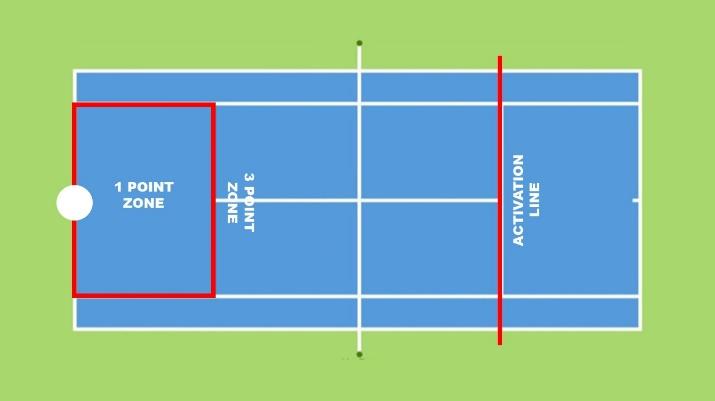
The game is played on either a Netball court or depending on the venue can be played on a Tennis court. There is one goal area, in a half court style of playing area with an activation line. Goals can be shot by any attacking player from within the goal area for one (1) point or outside for three (3) points. Only two (2) attacking and two (2) defending players are allowed in the goal area at any one time. Venue dependant, all games will be played on a netball court, however, if games are played on a tennis court, please see below diagram of how the court will be set out.
STARTING PLAY: (Using a Netball Court) The team starting with the ball at the beginning of each quarter starts play at the halfway point (centre circle). Once the Event Host blows the whistle game will commence and the ball can begin to be passed down the court.
SCORING A GOAL: Each team has to cross the activation line (half way), before they become eligible to score. Once the ball has crossed half way they become the attacking team, and they can begin to try and make their way back down the court to score.
CHANGE OF POSSESSION: When possession of the ball is turned over the team in possession need to play the ball back over the activation line (half way) before they can try and go for a goal.
-
A team member must catch or land with the ball with both feet on the ground past the activation line (half way) before continuing to play the ball back towards the goal.
-
There will be no stop in play; the team having completed the crossing of the activation line immediately continues playing the ball.
-
If a defending player tips or deflects the ball it is not a turnover unless the other team gets possession.
TURN OVERS OR SCORED GOALS: Once a team scores a goal the opposing team starts with the ball behind the end goal line. They are required to take the ball down the court and across the activation line (half way) before they can attempt to score themselves. This also applies to an intercept, as you can only score once you have crossed the traverse line and gained possession of the court.
SHOOTING:
-
3 POINT SHOTS: Must be taken from outside the goal circle only, within the goal third.
-
1 POINT SHOTS: Must be taken from within the goal circle.
-
NO dunking is permitted and jump shots are at your Event Hosts discretion.
SANCTIONS:
THERE ARE TWO TYPES OF PENALTIES IN NETBALL, FREE PASS & PENALTY PASS;
FREE PASS: Is awarded for infringements on the court involving one player. The pass is taken where the infringement occurred by any player who is allowed in the area. The offending player does not have to stand beside the thrower taking the pass. If a free pass is awarded in the goal circle, the shooter may only pass the ball – not shoot for goal.
PENALTY PASS/SHOT: Is awarded for contact, intimidation and obstruction infringements. The pass is taken where the infringer was standing, except if it places the non-defending team at a disadvantage. Any player who is allowed in the area can take the pass. The penalised player must stand “out of play”. That is, beside and away from the player taking the pass and making no attempt to take part in play. This includes directing play, until the ball has left the thrower’s hands. However, the player taking the penalty has the option to either pass the ball immediately, or to wait for the infringer to stand out of play. If a penalty is given to a Goal Attack or Goal Shooter in the goal circle they are awarded a “penalty pass or shot”, meaning they can pass or take the shot from where the penalty was awarded.
STEPPING: Once a player has landed with the ball, the first landed foot is called the grounded foot and must either stay on the ground or in the air until the ball is passed on. Re-grounding that same foot a second time while still in possession of the ball is a step which will result in a free pass to the opposition. Similarly, a hop, slide or drag of the grounded foot is not permitted.
PLAYING THE BALL: Once the ball has been caught; the player must pass it or shoot for goal within three seconds.
OBSTRUCTION: A player with arms extended cannot defend a player with the ball closer than 0.9m (3 feet). This distance is measured from the first landed foot of the attacking player to the nearer foot of the defending player. A player may stand closer to an opponent without the ball provided their arms are not extended, but a player may not use intimidating actions against an opponent with or without the ball. If the defending player has their defensive stance and the attacking player lessens the distance in their throwing or shooting action, then the defending player is not considered to be obstructing because it was the attacking player and not the defending player who shortened the distance.
CONTACT: A player cannot accidentally or deliberately come into contact with another player in a way which impedes their play. For example, pushing, charging, tripping, throwing the body against an opponent or using the ball to push or contact an opponent. Players must not hold an opponent, nor keep their elbows against another player. Players must not run with the arms extended across any player.
PLAYING THE BALL (REPLAY): A player who has possession of the ball may not bounce the ball and regain possession of the ball (replay it). If a player does not catch the ball cleanly, it may be allowed to bounce once to gain possession or batted or bounced to another team mate. After throwing the ball, a player cannot play it again until it is touched by another player, or rebounds off the goal post. A player cannot:
-
punch, roll, kick or fall on the ball;
-
gain or pass the ball in any way while lying, sitting or kneeling on the ground;
-
use the goal post as a way to regain balance or as a support while stopping the ball from going out of court.
-
When shooting, the ball must touch the goal ring before the player who shot the ball can regain possession again (replay).
THROW IN: When the ball goes out of court, the Event Host will try to see who made the last touch on the ball. In the circumstance when the Event Host does not see who touched the balls, players should make an honest call themselves. The throw in is then taken by a player from the opposing team close to where the ball went out of court. Standing close to the line from the outside of court, the player has three seconds to get the ball back in play.
FOOTWORK;
ONE-FOOT LANDING: When a player lands on one foot they may step with the other foot, lift the landing foot, but must throw the ball before re-grounding the lifted foot. They may use the landing foot as a pivoting foot, stepping in any direction with the other foot as many times as they wish. Once the pivoting foot is lifted they must pass or shoot before re-grounding this foot.
TWO-FOOT LANDING :If a player catches the ball and lands on both feet simultaneously, they may step in any direction with one foot, lift the other foot but must throw or shoot before re-grounding this foot. They may pivot on one foot, stepping in any direction with the other foot as often as they wish. Once the pivot foot is lifted they must throw the ball before re-grounding this foot. They may jump from both feet on either foot, or step and jump but must throw or shoot before re-grounding either foot.
HOCKEY SPECIFIC RULES
THE OBJECT OF THE GAME: The aim in a game of hockey is for the players to get the ball into their attacking circle, and push into the goal. The team with the most goals at the end of the game wins
THE FIELD: The field is considered to be the whole area of the pitch including the area behind the goals. Rebounds from all surfaces are aloud including the walls and the fence. The height and width for the goals shall be 3 feet and 4 feet.
THE TEAM: The number of players required on the court, for this league is five (5). There is no goalie in this league, you should play two offensive, two defensives, and a modified sweeper
STARTING PLAY: Games start with a scissors paper rock. The team who wins, chooses their direction, and also starts with possession of the ball at the beginning of the half. At the beginning of the second half, the other team start with the ball. After a goal has been scored, the defending team start the play from the middle of the field.
SCORING: Players can only shoot goals from within the box, before they can shoot. A goal is scored when the ball passes completely across the plane of the goal line. Goals will not count if a stick blade is above the waist level, if it is “hit”, “kicked” or the hand bats the ball.
PLAYING THE BALL: The ball must only be “pushed” or “passed” to your team mates. Due to the size of the field, hits, scoops, flicks, and slap shots are unnecessary and will result in a penalty. You are allowed to make long, and hard passes, but the ball should not go above knee height.
OUT BALLS: Balls going out of bounds are brought in from the corner by the defensive team, regardless of which team touched the ball last. Any ball going out of bounds that strikes a wall or other object and comes back into bounds is considered to be in play. When a team takes possession of the ball after it goes out-of-bounds, the opposing team must give that player 5 feet and 3 seconds to play the ball.
OBSTRUCTION: Players must not use their body to defend the ball when stationary, they may only use their body while the ball, and player are in motion, otherwise a penalty will be called, and the possession will be awarded to the other team.
HIGH STICKING: Any ball contacted by a stick above the height of the waist (of the player who is doing the high-sticking) is considered to be high-sticking, and the opposing team will receive possession. Needless to say, any goal scored in this manner will not coun
FOULS: The stick must not Fouls are when a player uses the body or the stick in any manner to strike, attempt to strike, trip, attempt to trip, push, hold, charge, obstruct, including third-party, or cause dangerous play. Penalty will be change of possession.
URBAN REC SPECIFICS
FUN FIRST POLICY
All Urban Rec leagues, irrespective of skill level, are fun-first. Our Event Hosts facilitate a fun, safe environment for teams. They will acknowledge, coach and make calls according to your level of experience playing the game. Urban Rec leagues expect a certain level of self-officiation, meaning that players are expected to display good sportsmanship to govern their behaviour. Open communication and camaraderie between teams is encouraged.
DISCIPLINE
Urban Rec Event Hosts have the final say on any issue that cannot be self-resolved.
If you are seen to be rude or not playing within the respect of the rules, your Event Host has the right to ask you to sub and take a break. If your Event Host then has to warn you more times then they have the right to ask you to leave the field or court and an assessment will be made if you can return to play. We don’t tolerate idiots, play fair.
INCLUSION
Urban Rec seeks to provide a safe, inclusive and happy environment for our members, staff and participants. Gender diverse, transgender and non-binary participants are welcome to play within our leagues along with any sexuality and persons from any background. Urban Rec has zero tolerance for bullying, discrimination or sexual harassment.